What Happens When We Actually Touch the Soil?
We already know that gardening gets us outside, makes us move and puts fresh food on the table. But scientists are beginning to ask a rather more intriguing question: could some of the benefits come from the microscopic life in the soil itself?
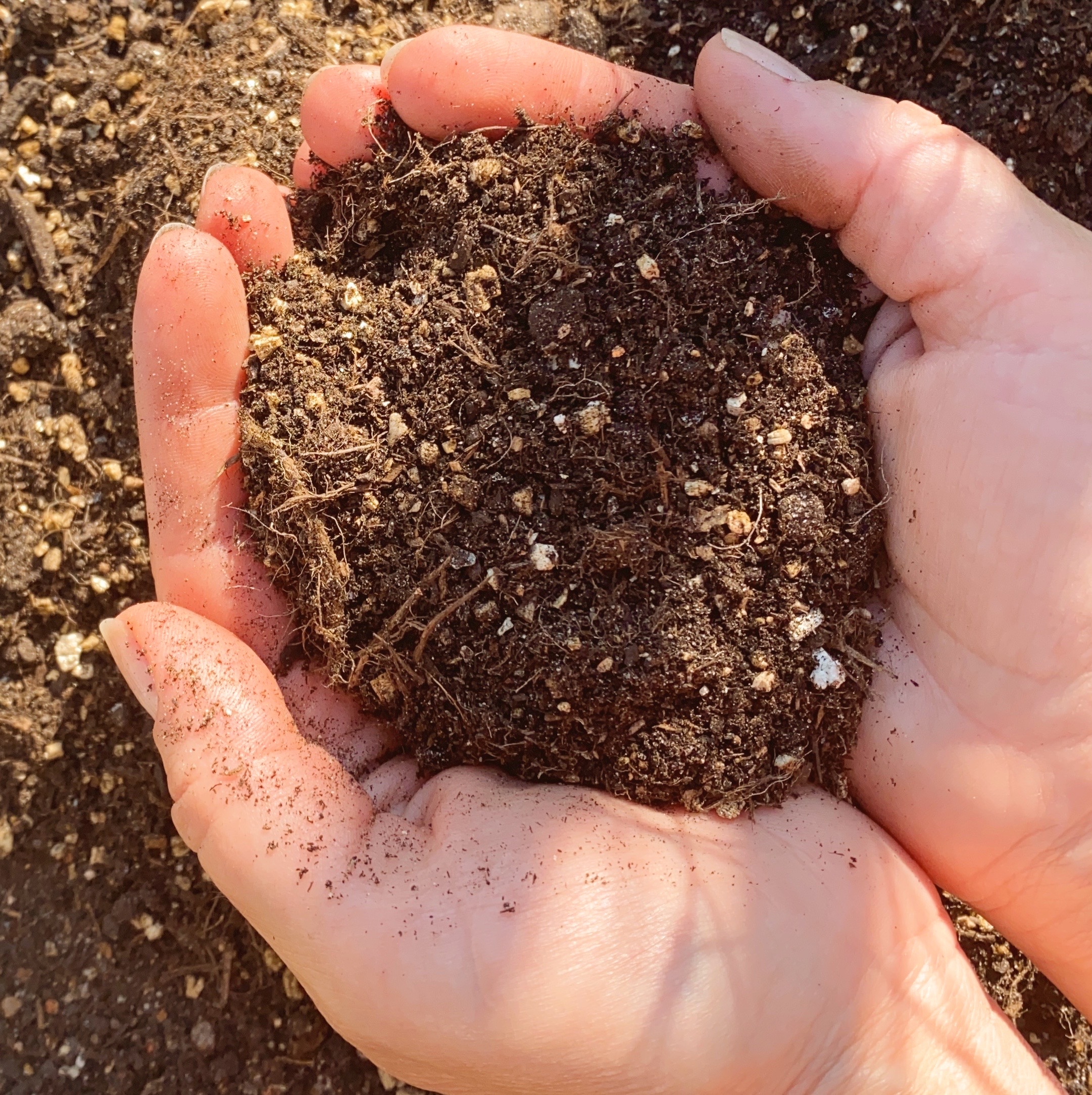
I had my hands in the soil the other day. Nothing unusual about that. I was probably pulling something out, putting something in, or doing one of those little jobs that begins with I'll just quickly check this bed and somehow turns into a relaxing half an hour in the garden.
I do own gardening gloves. Several pairs, in fact. I wear them when I'm dealing with something thorny, rough or particularly unpleasant, but for many of the smaller jobs in my vegetable garden I don't bother. There is something rather satisfying about feeling the soil with your hands. You can tell immediately whether it is dry, damp, crumbly or compacted in a way that is much harder through a glove. Seeds are easier to handle, tiny weeds come away neatly and, yes, you end up with dirt under your fingernails.
For most gardeners, none of this feels remotely remarkable, which is actually rather funny when you think about it. We live in a world in which we disinfect kitchen counters, wash our hands, sanitise surfaces and generally spend a considerable amount of effort trying to keep bacteria away from ourselves. Then we walk outside, plunge our hands into a substance containing an almost unimaginable community of microorganisms and somehow regard the entire experience as wholesome.
Perhaps our instincts haven't been entirely wrong.
I recently came across some research that made me look at this very ordinary garden habit rather differently. I expected the familiar story about gardening being good for us because it gets us outside. We move, we get daylight, we slow down, perhaps we feel less stressed. All perfectly good reasons to spend time in a garden.
But the researchers weren't asking people how relaxed they felt after tending their plants. They were looking at changes on their skin and at markers in their blood.
That got my attention, because the question they were asking was much more interesting than does gardening make us feel good?
They wanted to know what happens when the microbial world living in soil comes into contact with the microbial world living on us.
Despite our enthusiasm for cleanliness, we aren't remotely sterile ourselves. Our skin, digestive system and other parts of the body are home to enormous communities of bacteria, fungi and other microorganisms. Collectively, these communities form our microbiota, and researchers have become increasingly interested in how those microbial communities interact with our bodies and how much the environments in which we live influence them.
Which brings us back to my grubby hands.
What scientists found in a month of gardening
One study I found particularly interesting was published in 2024. Adults were asked to grow edible plants indoors during winter, but there was an important difference in what they were gardening in. One group received growing material containing a diverse community of environmental microbes, while another received material that looked similar but was microbiologically much poorer.
And that was essentially it. Nobody moved to a farm or spent six months living barefoot in a forest. They grew edible plants indoors for a month.
Afterwards, researchers found increased diversity among several groups of bacteria on the skin of participants who had used the microbially rich material. They also measured changes in IL-10, a signalling molecule involved in regulating immune responses.
This is exactly the sort of finding that can very quickly acquire a headline along the lines of Gardening boosts your immune system!, which is not what the study proved.
The human immune system is far too complicated for that conclusion, and a measurable biological change doesn't automatically mean that somebody will become healthier or less likely to develop a particular disease. What the researchers showed was subtler: changing people's exposure to environmental microbes changed what they could measure in the participants' skin microbiota and in aspects of immune regulation.
I actually find that more interesting than the exaggerated version, particularly because these changes were detected after only a few weeks.
Other experiments have approached the same question in different ways. In one, participants rubbed their hands in microbially diverse soil several times a day for two weeks, after which researchers again detected changes in microbial communities and aspects of immune response. Studies involving contact with plants and growing media have demonstrated something beautifully simple as well: microbes move between the things we touch and our skin.
Touch soil and some of its bacteria can temporarily end up on your hands. Touch plant material and another exchange takes place. Wash thoroughly with soap and much of that change disappears again.
I've been thinking about that ever since I read it.
We tend to imagine skin as the boundary that keeps the outside world out, but perhaps a border is a better image. Borders aren't necessarily sealed. There is traffic across them, and for most of human history much of that traffic would have come from extraordinarily diverse natural environments.
Humans lived much closer to soil, plants, animals and natural materials than many of us do now. Today a large proportion of life happens indoors. We work behind screens, walk across manufactured surfaces, live in climate-controlled buildings and can go for surprisingly long periods without touching anything resembling actual soil. Even gardening can become quite a sanitised activity if we want it to be.
This is part of the thinking behind what researchers call the biodiversity hypothesis. In very simple terms, humans evolved in continual contact with an enormous diversity of environmental microorganisms, while modern urban life has reduced much of that exposure. Scientists are now asking whether this change in our surroundings may also influence the microbial communities associated with us and the way our immune systems develop and regulate themselves.
There is still a great deal we don't know, and that is important. This research doesn't tell me that I should throw away my gardening gloves or prescribe half an hour of digging to anyone who wants to improve their health.
What it has done is make me notice how often ordinary gardening brings me into contact with soil without my ever thinking about it.
If I sow radishes, my fingers are in the soil. When I transplant lettuce, they're there again. I pull carrots, plant garlic, remove weeds, harvest beetroot, move compost and brush earth from the roots of spring onions before carrying them into the kitchen.
I don't need to schedule fifteen minutes of soil exposure at 8.30 in the morning. I have vegetables.
And perhaps that ordinariness is one of the things I find most interesting about the whole subject. We have become very good at turning health into deliberate activities: take this supplement, complete this workout, follow this programme, perform this wellness practice for twenty minutes.
Nature rarely works in twenty-minute appointments.
For most of human history, contact with soil, plants and other living organisms wasn't something we deliberately did because somebody had told us it might be good for us. It was simply part of the environment in which human life happened.
A garden is more than something green to look at
None of this means that dirt is automatically good for us, of course. It would be rather ironic to respond to an oversimplified fear of microbes with an equally oversimplified enthusiasm for them.
Hygiene has saved an extraordinary number of lives. Clean drinking water, sewage systems, safe food handling, infection control and washing our hands at appropriate times are very good ideas that I have absolutely no intention of abandoning because I've become interested in soil microbiology.
Nor is every handful of soil something I particularly want against my skin. There is an obvious difference between healthy garden soil and soil that may be contaminated, and there are perfectly sensible reasons to wear gloves if you have cuts or certain skin conditions, or when you're handling thorny plants, animal waste, some composts and manures, or anything else where protection simply makes sense.
I wear gloves when the job calls for them. I just don't automatically treat my vegetable garden as something from which I need to protect myself.
Most of the time I put my hands in the soil.
What this emerging research suggests isn't that we should abandon soap and start eating compost. It is something considerably more nuanced: the microbial diversity of the environments around us may interact with our bodies in ways we're only beginning to understand.
And that question becomes much bigger than gardeners' hands.
Researchers have started looking at what happens when more biological diversity is introduced into the places where people actually live, work and play. Experiments involving living green walls, biologically richer play environments for children and more biodiverse urban spaces have found measurable changes in people's microbial communities and immune-related markers.
Again, those findings don't give us a prescription for better health. The studies are still building a picture rather than providing a final answer. But together they raise an intriguing possibility: our relationship with nature may be microbial as well as visual.
I've found myself thinking about that when I look at the way we design our gardens and towns.
We often talk about making places “greener”, but green can mean very different things. A clipped lawn surrounded by paving technically contains vegetation. So does a row of identical ornamental shrubs in an otherwise hard-landscaped space. Artificial grass can even give us the colour green, if we're being particularly generous with the definition.
None of those things creates the same biological environment as healthy soil filled with roots, herbs, vegetables and flowers, with insects moving between them, fungi below the surface and fallen leaves and other organic matter gradually becoming part of the soil again.
We already have very good reasons to care about that distinction. Biodiverse gardens provide food and habitat for wildlife. Healthy soil can absorb water. Vegetation helps cool urban spaces and flowering plants support pollinators.
But perhaps there is another relationship in there that we've barely begun to understand: the relationship between the biodiversity immediately surrounding our homes and the microscopic communities associated with us.
I find that idea rather wonderful, partly because I have no desire to turn my vegetable garden into another health programme.
I started growing food because I wanted food, and that still seems an excellent reason. There is something deeply satisfying about walking outside before dinner and coming back with lettuce, herbs, a few carrots and whatever else happens to be ready. The garden feeds us, gets me outside, keeps me moving and makes me pay attention to weather and seasons in a way I probably wouldn't otherwise.
It doesn't need to become medicine to justify its existence.
But the next time I'm standing beside a raised bed with soil on my hands, I'll probably look at those grubby fingers slightly differently.
The soil beneath them isn't just the brown stuff holding up my vegetables. It's an extraordinarily complex living environment, full of organisms I will never see, and every time I sow, weed, harvest or simply crumble a handful between my fingers, there is contact between that world and mine.
I've been busy thinking that I'm growing vegetables in the soil.
It turns out the relationship may be rather more interesting than that.
Want a gentle step-by-step start? Download the free Starter Guide and begin with clarity, not overwhelm.