When the Tomato Season Is Over, the Harvest Isn't
There comes a point every autumn when leaving tomatoes on the plant stops being patience and starts becoming wishful thinking. Fortunately, bringing them indoors does not mean the harvest is lost.
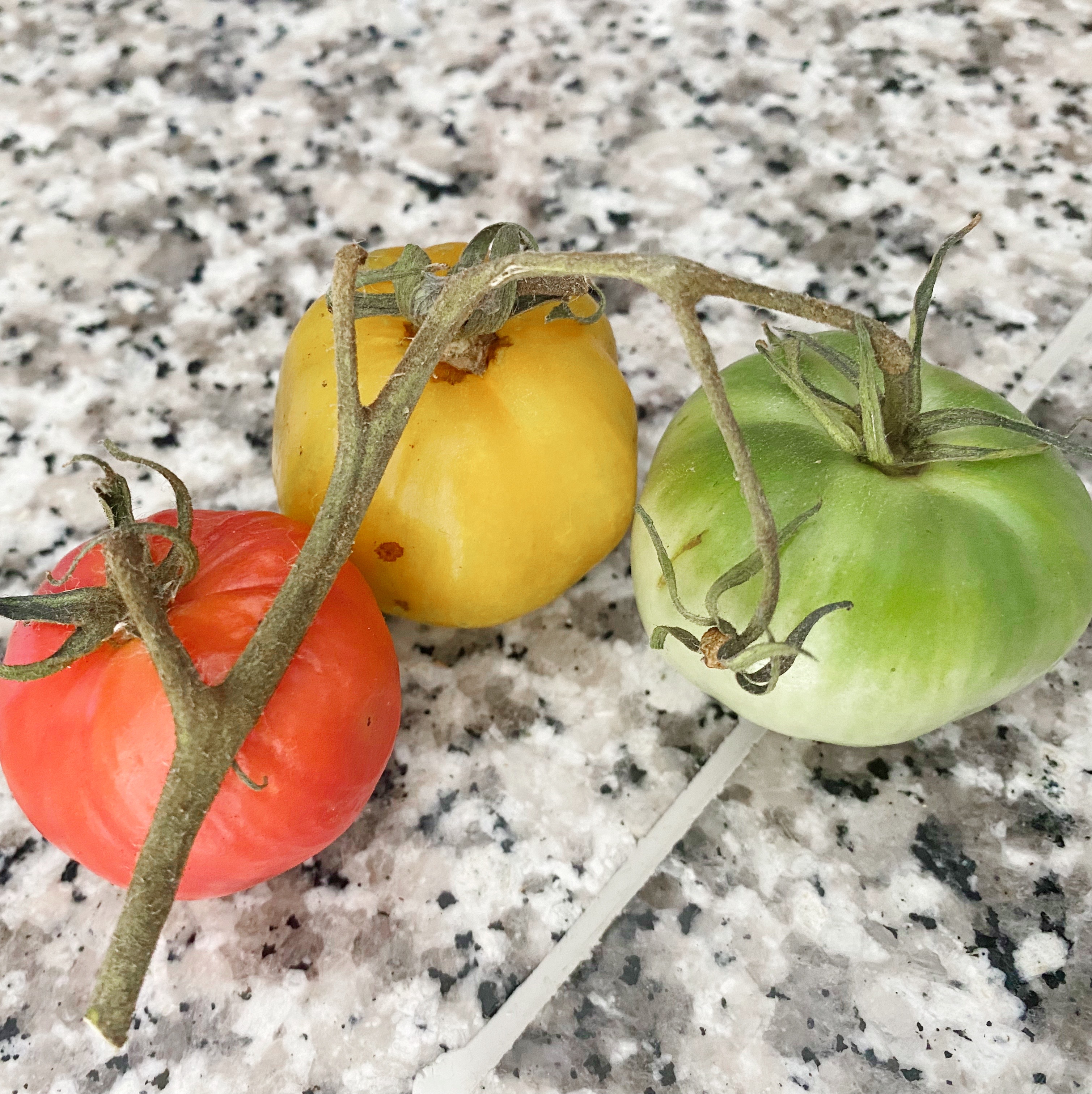
There is always a slightly awkward stage in the tomato season.
In August, there is absolutely no doubt about what is happening. The plants are enormous, vigorous and unapologetically productive. Tomatoes seem to ripen almost faster than I can use them, the kitchen counter fills up, and dinner planning becomes less about deciding what I feel like cooking and more about working out where another kilo of tomatoes might reasonably go.
By September, things become less straightforward.
There are still beautiful fruits hanging on the plants. Some are red, some are blushing, and others are pale green and clearly thinking about it. On a warm afternoon, with the sun still reaching the garden, it is quite easy to convince myself that summer hasn't really gone anywhere.
The plants are less convincing.
Their leaves are tired. The nights are cooler. Morning dew lingers longer, and everything takes that little bit more time to dry. Growth has slowed and, if I'm being sensible rather than sentimental, I know these plants are no longer the magnificent tomato factories they were a month ago.
Still, there are all those tomatoes.
So the annual negotiations begin.
Perhaps I'll give them another week.
One more run of sunny days might do it. That large green tomato is almost full-sized. Surely it will start changing colour soon. October might be exceptionally warm this year.
Sometimes it is.
And if the plant is healthy, the forecast looks promising and the tomatoes are still ripening, I'm perfectly happy to leave them where they are. I don't remove tomato plants simply because the calendar says September.
But eventually there comes a day when I stand in front of them and know that patience has quietly turned into wishful thinking.
That's when I pick the lot.
And strangely enough, I've come to enjoy that final harvest almost as much as the glorious ones in August.
The basket looks very different, of course. There will be a handful of properly ripe tomatoes, quite a few that have started to colour, several perfectly formed but stubbornly green ones and inevitably a collection of tiny fruits that arrived at the party far too late.
Years ago, I think I regarded those green tomatoes as slightly disappointing. After spending months nurturing a plant, surely the objective was to have every last tomato reach perfect glossy redness while still hanging from the vine?
I don't think that way anymore. I carry the basket into the kitchen and start sorting.
Some of those green tomatoes aren't really as unripe as they look. A tomato eventually reaches what growers call the mature-green stage: it has completed most of its physical development even though the visible colour change hasn't begun. Picked at that point, it is perfectly capable of continuing the ripening process indoors.
After enough tomato seasons, you get surprisingly good at recognising them.
They have the weight and fullness of a proper tomato rather than the hard, slightly mean appearance of a fruit that has only just formed. The dark green begins to soften into a paler shade, sometimes almost whitish around the blossom end, and occasionally there is the faintest hint that colour is about to break through.
Those tomatoes go into one group. The little hard green ones go into another. And the tomatoes that are already red or blushing tend not to remain in a group for very long because by this point I am usually thinking about dinner.
This is where the tomato season quietly moves from the garden into my kitchen.
Not every tomato needs a sunny windowsill
For some reason, we have developed a collective instinct to put green tomatoes on windowsills. Pick the final tomatoes, find the sunniest window in the house and line them up beautifully along it.
It looks lovely. It isn't particularly necessary.
Once a tomato is mature enough, its ripening is largely controlled by what is happening inside the fruit, including the action of ethylene, the natural plant hormone involved in ripening. It doesn't require blazing sunshine to turn red.
I would much rather keep mine somewhere at a comfortable room temperature where I can see and check them easily. And checking them matters, because the final tomatoes of the year have absolutely no intention of ripening in an orderly fashion.
One will suddenly be perfect while its neighbour remains resolutely green. Another develops a soft spot when you're not looking. One damaged tomato hidden at the bottom of a bowl can quickly become everybody else's mould problem.
So I spread them out rather than piling them deeply, and I have a look every few days.
If I particularly want to speed things along, I can put a few into a loosely closed paper bag or box with an apple or banana, both of which release ethylene. But after several weeks of trying to keep up with peak tomato season, I am rarely desperate for every remaining tomato to ripen at once.
Three or four becoming ready every few days feels almost civilised. Do they taste exactly like a tomato that ripened outside in August, warm from the sun? No. And I don't see any reason to pretend otherwise.
A beautiful vine-ripened summer tomato, picked at exactly the right moment from a healthy plant, is difficult to beat. There is a reason I spend months growing them. But I think we can become unnecessarily snobbish about the ones that finish ripening indoors.
A properly developed tomato brought inside at mature green or at the first colour break can still become a perfectly enjoyable tomato. Would I choose my last indoor-ripened specimen for a dish where the tomato is the entire event — thickly sliced, perhaps, with nothing more than good olive oil and salt?
Probably not.
Would I happily put it into a pasta sauce, shakshuka, soup, curry, tart or a tray of roasted vegetables?
Absolutely.
Not every tomato needs to audition for a starring role. Some are excellent supporting actors. And by this point in the year, that suits the way I want to cook anyway.
At the height of summer, my chef instinct is mostly to leave a good tomato alone. If I have just picked something perfectly ripe and still warm from the garden, it needs very little help. Olive oil, salt, perhaps some basil. Mozzarella if there happens to be some in the fridge. A piece of good bread.
The final basket is different. There might be a few split fruits, some strange shapes, tomatoes that are softer than I would like for a salad and others that simply don't have August's sweetness. None of that bothers me. This is cooking-tomato territory.
A tray of them will often end up in the oven with olive oil, garlic and whatever herbs I have within reach. Roasting drives off some of the water and concentrates the flavour, which is exactly what a late-season tomato needs. We might eat them that evening with meat or fish, toss them through pasta or pile them onto toasted bread. Quite often I turn the whole tray into sauce. And then I freeze it.
I know there is something wonderfully romantic about shelves filled with identical jars of preserved summer produce, but I have never believed in making life unnecessarily complicated in the name of being a “proper” gardener. My freezer is one of my favourite preserving tools.
Tomatoes can even go into it whole if there isn't time to deal with them immediately. Once defrosted, the skins come away very easily. The texture will obviously be far too soft for a salad, but if they're heading for soup or sauce, who cares?
More often, I cook them first and freeze portions of fairly simply seasoned tomato sauce. I deliberately don't turn every batch into a finished pasta sauce because I don't yet know what I'll want to eat in February. Keeping it simple means one container can eventually become Italian, Spanish, Middle Eastern or something entirely different. That flexibility is far more useful to me than thirty identical jars.
Sometimes, if the final cherry tomatoes are particularly good, I'll treat them rather more luxuriously and make a tomato confit, cooking them gently with olive oil, garlic and herbs until they become soft, rich and intensely tomatoey.
That's not really an attempt to preserve August. It's a transformation. And perhaps that is the point I have come to appreciate most about the end of a harvest. We don't always need to keep an ingredient exactly as it was at its peak. Sometimes the interesting part is discovering what else it can become.
And then there are the ones that really are green
Back on the kitchen counter, there is still that second pile. The genuinely immature tomatoes. These are the ones that could sit beside a banana until Christmas and still never become the tomato of my dreams. They're too young, too hard and simply haven't developed enough to ripen properly.
But that doesn't make them waste. It makes them green tomatoes. Once I stopped regarding them as failed red tomatoes, they became much more interesting.
Their firmer texture and sharper flavour work in things where a soft, sweet ripe tomato would actually be less useful. Green tomato chutney is a classic for good reason: that acidity is lovely with onions, spices, vinegar and a little sweetness, particularly alongside cheese, cold meats or something smoky from the barbecue.
They can be pickled too. Thin slices in a sharp pickle are excellent tucked into sandwiches or burgers, especially when there is something rich enough to need that acidity.
And yes, fried green tomatoes exist for a reason.
More recently, I've also been experimenting increasingly with fermentation. Firm green tomatoes lend themselves rather nicely to it because they hold their texture. A salt brine, garlic, herbs, perhaps some spices, and suddenly the awkward little remainder of the tomato crop has become an experiment I am genuinely looking forward to eating.
This is one of the things I love about growing food. The garden doesn't merely provide ingredients. It dictates them.
If I shop for dinner, I can decide what I want and buy accordingly. A garden is considerably less accommodating. It gives me three courgettes when I wasn't planning to eat courgettes. It produces more cucumbers than two people can reasonably consume fresh. It hands me a basket of green tomatoes at the end of the season and effectively says, Right, chef. What are you going to do with these?
That makes me cook differently. A glut becomes sauce. Cucumbers become pickles. Green tomatoes send me down a fermentation rabbit hole I might never have explored if I hadn't needed to find something useful to do with them.
Scarcity can make us inventive. Abundance does too.
And I think that is part of the reason my chef life and my gardening life have become so intertwined. Growing food has made me more flexible in the kitchen, while being a cook means I don't need every vegetable in the garden to conform to the supermarket version of itself before I can see its value.
The radish leaves are food. The pea shoots are food. The slightly ugly tomato is food.
And the green tomato is not waiting to become useful. It already is.
Meanwhile, outside…
Eventually I return to the garden and deal with the plants themselves.
Once I've made the decision, I don't leave them standing around out of nostalgia. By now they have usually been producing for months. They've done their job magnificently, and there is little value in asking them to limp through increasingly cold, damp weather simply because I'm reluctant to acknowledge that summer is over.
So out they come. There is always something slightly shocking about it. A mature tomato plant occupies an enormous amount of visual space. For months it has been one of the dominant things in the garden — all stems and leaves and supports and fruit — and then, within minutes, it is gone.
Suddenly there is soil again. An empty square.
Except I don't really see it as empty anymore.
Perhaps winter spinach will go there. Perhaps Pak Choy. Perhaps lettuce. Whatever follows, the space the tomato occupied has another job almost immediately.
I rather like that moment.
Inside, the last of summer is roasting slowly with garlic and herbs, or ripening quietly on the kitchen counter. Perhaps there is a jar of green tomatoes beginning to ferment.
Outside, an entirely different crop is already taking over.
There is no clean line between one gardening season and the next. One simply folds into another. And perhaps that is why I no longer feel remotely disappointed by the final tomato harvest.
August gives me tomatoes that barely make it into the house before I eat them. Autumn gives me something else. It gives me trays of roasted tomatoes, portions of sauce tucked into the freezer for winter, jars of something sharp or fermented, and a little row of fruits quietly changing colour indoors long after their plants have disappeared.
The harvest hasn't failed because every tomato didn't turn red on the vine. It has simply changed.
And sometime in February, when I take one of those containers of tomato sauce from the freezer and discover that the spinach outside has survived another cold week, the boundary between one season and another will feel rather irrelevant anyway.
The tomato plants may be long gone.
But I'm still eating from them.
Want a gentle step-by-step start? Download the free Starter Guide and begin with clarity, not overwhelm.